Villaluenga: hiker rescued after being trapped 40 meters up in the Sierra de Caíllo
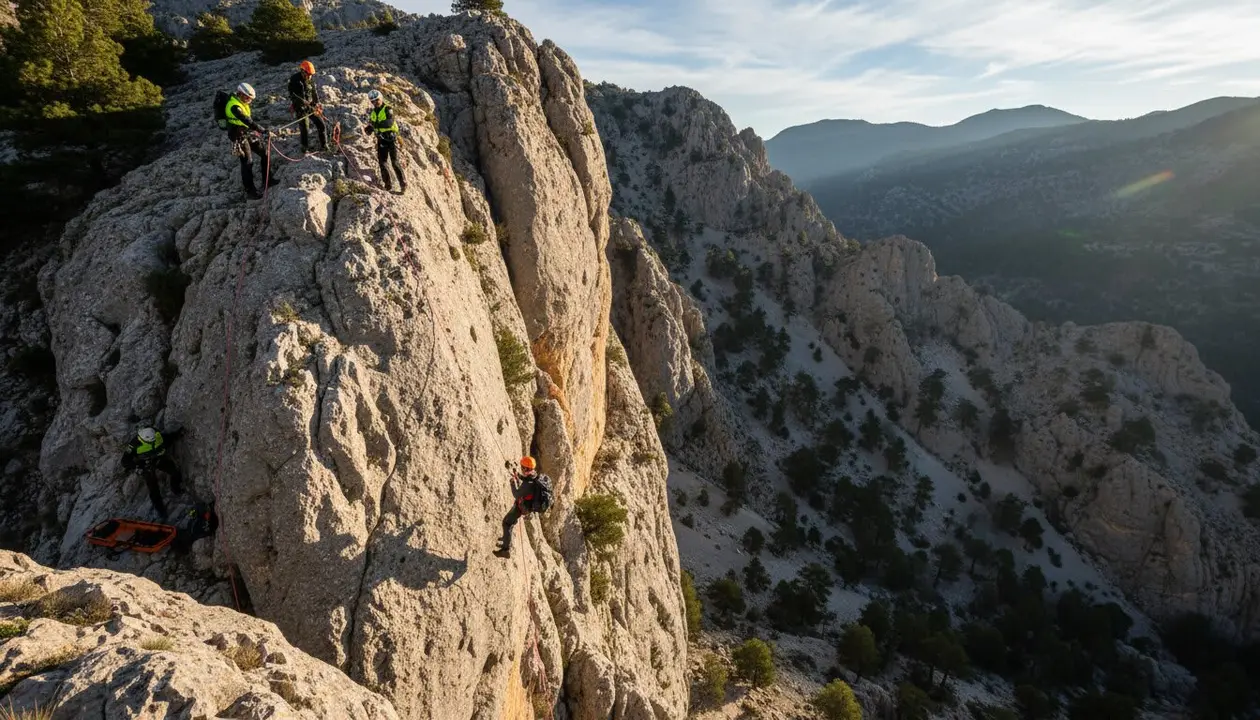
A hiker has been rescued about 40 meters high in the Sierra de Caíllo, in Villaluenga del Rosario. The man got trapped while trying to shorten the path to the town through an area of steep slope, rocks, and impassable terrain. The GREIM from Ubrique had to climb up to him and perform a secured descent to the ground.
The Rescue Occurred in an Area of Steep Slope
Where did the hiker get trapped?
The alert placed the hiker in the middle of a mountain in the Sierra de Caíllo, within the municipal area of Villaluenga del Rosario, in the province of Cádiz. He was about 40 meters high, in an area marked by steep slope, rocks, and orography that prevented continuing to walk.
For those who know the paths of the mountain range, this information explains the difficulty of the intervention: it was not simply about locating a lost person on a trail, but reaching someone stopped on a mountain wall without an easy way out by their own means. The slope turned a walk into a risky situation.
The hiker had gone for a walk on a trail and decided to shorten the route to reach the town downhill. The idea seemed straightforward, but the terrain changed as he descended. The rocks and the mountain’s configuration ended up blocking the passage.
And there lay the problem. The path stopped being passable and the man got trapped, furthermore, without wearing the appropriate clothing or footwear to face an area with such characteristics. A shortcut that ended up being anything but short.
Why did the area complicate the exit?
The combination of height, slope, rocks, and lack of suitable equipment prevented the hiker from continuing the descent safely. The information provided about the rescue does not indicate that he suffered injuries, but it does describe a compromised position that required specialized intervention.
In this type of terrain, each movement can increase the risk of falling or leave the person even more exposed. Therefore, the priority was to access the assisted person with mountain equipment, secure the maneuver, and accompany him throughout the descent. **The exact location and the 40 meters of height determined the response.**
The intervention also shows the difference between a recognizable path and a route that becomes impassable when leaving the planned track. The hiker intended to go down toward Villaluenga del Rosario, but the orography forced him to stop before reaching a safe area.
How the GREIM from Ubrique acted to bring him down
How did the agents reach the man?
The Special Rescue and Mountain Intervention Group (GREIM) from Ubrique moved to the area after receiving the alert about the trapped hiker. The agents accessed by climbing up to the height where he was and prepared the necessary system to work on the wall.
The maneuver included placing intermediate floating anchors and setting up an anchorage point above the assisted person. These elements allowed establishing a safety line during access and the subsequent descent, in an operation conditioned by the slope and the height.
The rescuer continued until reaching the hiker. Once next to him, he placed a harness on him and anchored him to the rescuer himself. The approach was planned step by step, avoiding that the person had to face alone the most exposed stretch of the mountain.
The technical detail matters because it explains why the Civil Guard activated the GREIM based in Ubrique and did not treat the incident as an ordinary assistance. **The rescue required knowledge of climbing, anchors, and vertical descent.**
How was the descent to the ground?
After securing the hiker with the harness and connecting him to the rescuer, both started the descent of approximately 40 meters. The descent was carried out with the system installed by the agents and under the protection of the specialized personnel who had reached the wall.
The operation made it possible to get the man out of the area where he had been stuck and bring him to the ground. The source does not provide a specific duration of the rescue nor details the exact finishing time, so the verifiable data is the approximate vertical route and the procedure used.
Once down, the work did not end at the descent point. The hiker still had to leave the mountain area and reach his vehicle. The Civil Guard accompanied him on foot, with support from Firefighters and the Local Police of Villaluenga del Rosario.
The accompaniment was the last part of an intervention in two stages: first, the wall of the Sierra de Caíllo; then, the walk to the vehicle. Only then could he continue on his own. First they had to get him out of the mountain; then, leave him able to leave.
What this Rescue Leaves in Villaluenga del Rosario
Which organizations participated in the Intervention?
The operation brought together several emergency and security services from the municipality and the area. The Civil Guard of Cádiz received the alert and activated the GREIM of Ubrique, whose agents carried out the technical part of access and descent from the wall.
Firefighters and the Local Police of Villaluenga del Rosario also collaborated. Their participation focused on accompanying the hiker on foot to his vehicle once the mountain maneuver had ended.
- Civil Guard of Cádiz: received the alert and coordinated the action.
- GREIM from Ubrique: climbed up, installed the anchors, and carried out the descent.
- Firefighters: collaborated in the subsequent accompaniment.
- Local Police of Villaluenga: also participated in the foot transfer to the vehicle.
The sequence shows a coordinated response, with different roles depending on the stage of the rescue. GREIM took on the technical access to the wall, while Firefighters and Local Police helped when the hiker was already on the ground.
What happened to the hiker afterward?
After completing the descent from approximately 40 meters, the agents accompanied the person on foot to his vehicle. The source states that after this accompaniment, he was able to continue on his own.
No injuries, medical transfer, or hospitalization are reported. Nor is there mention of other people involved. The confirmed fact is that the hiker got trapped during a walk, was located by the rescue operation, and left the area with the help of the deployed services.
For readers from the province of Cádiz, the case leaves a very concrete image: an improvised descent toward Villaluenga del Rosario ended on a mountain wall, 40 meters above the ground. The choice of an alternative path completely changed the conditions of the route and forced mobilizing a specialized group.
The story ends without further complications described by the source, but with an evident practical lesson in its own data: clothing, footwear, and the planned route are not minor details when the terrain presents rocks and a steep slope. In the Sierra de Caíllo, leaving the path had a considerable operational cost.
The rescue in the Sierra de Caíllo ended with the hiker next to his vehicle after an intervention by the GREIM from Ubrique at an approximate height of 40 meters. The operation combined climbing, anchors, harness, and secured descent, with the subsequent collaboration of Firefighters and Local Police of Villaluenga. The case reminds, with concrete facts, how a shortcut can turn a walk into a mountain emergency.
Frequently Asked Questions
- Where was the hiker rescued?
- He was rescued in the Sierra de Caíllo, within the municipal area of Villaluenga del Rosario, Cádiz. He was trapped about 40 meters high in an area of steep slope and rocks.
- Which unit carried out the rescue?
- The technical intervention was carried out by the Special Rescue and Mountain Intervention Group (GREIM) from Ubrique, belonging to the Civil Guard.
- How did they bring him down?
- The agents climbed up to the hiker, placed floating anchors and an anchorage point, put a harness on him, and anchored him to the rescuer to descend both to the ground.
- Did other services participate?
- Yes. Firefighters and the Local Police of Villaluenga collaborated by accompanying the hiker on foot to his vehicle after the descent.