The amazing Toyota Sora: 299 HP, 70 passengers, and 10 minutes
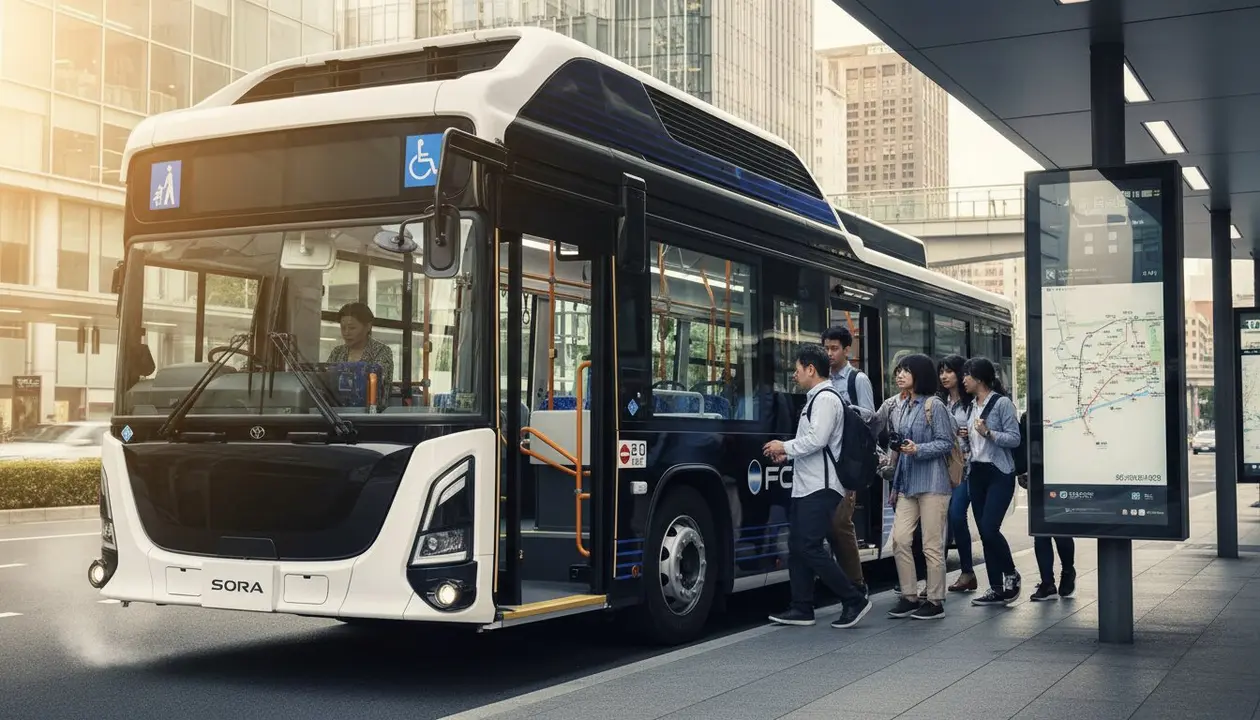

The new Toyota Sora places the fuel cell and hydrogen tanks on the roof to free up the entire bus floor. According to the source content published by Motor.es, this second generation reaches 220 kW, equivalent to 299 HP, offers more than 300 kilometers of range, and can transport 70 people. The improvement is not only in the power figure: the combination of quick refueling and greater range changes its daily usefulness.
The big novelty of the Toyota Sora
What does the second generation bring?
For the regular user, the decisive figure is not the 299 HP, but that the bus can cover a service day with much more margin than its predecessor. The original Sora offered about 100 kilometers of range; the new model declares more than 300 kilometers. This is a threefold jump over the previous reference.
Toyota has developed this second generation together with Isuzu Motors and uses the latter’s 100% electric flat platform. The fuel cell and tanks are placed on the roof, a solution that avoids placing mechanical elements under the rear area and keeps the floor completely flat.
The hydrogen tank capacity has increased by 20% compared to the first-generation Sora. Still, the manufacturer states that a considerable amount of weight has been saved and that the range has grown. That balance is the most interesting technical point of the project: more fuel stored, but without turning the bus into an unnecessarily heavy load.
Why do the 299 HP matter in a bus?
The two induction electric motors deliver 110 kW each, totaling 220 kW or 299 HP. The maximum torque reaches 970 Nm. It’s not about turning a collective transport vehicle into a sports car, of course, but about having an adequate electric power delivery to move a large and loaded body.
The comparison with the GR Yaris or the GR86 serves to scale the figure but also shows why power should not be interpreted in the same way. In the Sora, those 299 HP serve cruising regularity and transport capacity. The real interest lies in the electric propulsion integrating with a fuel cell, not in seeking flashy accelerations.
| Specification | Data |
|---|---|
| Total power | 220 kW, 299 HP |
| Motors | Two 110 kW induction electric motors each |
| Maximum torque | 970 Nm |
| Declared range | More than 300 km |
| Tanks | Three hydrogen tanks at 70 MPa, equivalent to 700 bars |
| Total tank volume | 471 liters |
| Refueling | About 10 minutes or less, depending on the station and ambient temperature |
More space and more flexible operation
How does the interior change with the flat floor?
For passengers, the electric platform has a very specific consequence: the rear steps that usually appear when the motor is placed in that area disappear. The result is a more continuous interior space, something especially useful when boarding people with reduced mobility, strollers, or wheelchairs.
The urban variant measures 10,545 millimeters long, 2,485 millimeters wide, and 3,440 millimeters high. It can carry 70 people in total: the driver, 19 seated passengers, and 50 standing. It also incorporates a fixation system that allows securing a wheelchair in place with a single gesture.
There is a practical reading behind these figures. The Sora is not designed as a small vehicle for very specific routes but as a bus capable of handling a high passenger load. The flat floor is not an aesthetic detail: it affects access, space distribution, and circulation inside the cabin.
What safety aids does it incorporate?
The new Sora adds driving assists common in passenger cars, including a blind spot monitor to detect pedestrians and cyclists in areas difficult to see from the cabin. In a vehicle of these dimensions, that assistance has a particularly clear function: improving vigilance of surroundings when the driver maneuvers or drives on streets with vulnerable users.
The provided information does not detail a complete list of systems nor offers independent safety test results. Therefore, the analysis must remain on what is confirmed: the blind spot monitor is part of the mentioned equipment and is aimed at identifying pedestrians and cyclists in limited visibility areas.
- Advantage for access: the flat floor eliminates rear steps.
- Capacity: accommodates 70 people, with 19 seated seats and space for 50 standing passengers, plus the driver.
- Accessibility: has a fixation system for wheelchairs.
- Assistance: includes a blind spot monitor for pedestrians and cyclists.
Refueling as a decisive argument
Can it refuel as quickly as a fleet needs?
For a transport company, the clearest advantage of hydrogen lies in downtime. Toyota states that the Sora can refuel completely in about 10 minutes, although this figure depends on the station’s capacity and ambient temperature. If stations improve their technology, the time could drop to about 5 minutes.
This places hydrogen in a different position compared to vehicles that need to remain connected for longer. Here, no exact electric charge duration can be stated nor costs compared, because the source content does not provide those data. It can be said that Toyota presents quick refueling as one of the central arguments of the new bus.
Four configurations have also been proposed: two variants for urban environments and two others aimed at connecting towns and cities. The declared range of more than 300 kilometers makes sense precisely in that second use, although the real range will depend on service conditions, load, and route; those factors are not quantified in the available information.
What role could it have in Europe?
The source content points out that these technologies will be very relevant in Europe from 2030 onward. The statement places the Sora within a broader transition in collective transport but does not specify countries, purchase timetables, or refueling networks. For now, the verifiable fact is the model’s orientation towards urban services and intercity connections.
The bus adds another striking function: it can use its energy as an emergency source during blackouts. It does not specify how much energy it could supply nor for how long, so it is not advisable to turn that possibility into an operational promise. Still, it introduces an additional utility for infrastructures that need to maintain basic services when the grid fails.
The propulsion system comes from a technological line that Toyota has already applied in the Mirai and in other projects, including work vehicles and sports prototypes. In this case, the evolution serves a collective vehicle, where range, downtime, and accessibility weigh more than maximum isolated power.
The second-generation Toyota Sora makes sense for fleets that need more than 300 kilometers of declared range and short refueling pauses. Its price does not appear in the source, so it is not possible to assess the acquisition cost yet. The decision will depend on the availability of hydrogen stations, the route, and the company’s ability to maintain compatible infrastructure.
- The best features: declared range over 300 kilometers, refueling in about 10 minutes, flat floor, and capacity for 70 people.
- Also adds: wheelchair fixation, blind spot monitor, and possible use as an emergency power source.
- The unknown: the source does not indicate price, operating cost, hydrogen consumption, nor specific station availability.
- Its practical limit: refueling time varies depending on the station and ambient temperature.
The reality is that the new Sora is not defined by having nearly 300 HP, but by combining more than 300 kilometers of range, fast refueling, and an accessible interior for 70 people. For urban and metropolitan transport, this combination is more relevant than any comparison with a sports car. Its final fit will depend on hydrogen infrastructure, but Toyota has already proposed a concrete response for fleets that cannot afford long stops.
Frequently Asked Questions
- How many people can the Toyota Sora transport?
- The bus can carry a total of 70 people, including the driver. It has 19 seats for passengers and space for 50 standing people.
- How long does it take to refuel the new Toyota Sora?
- Toyota states it can fully refuel in about 10 minutes. The time may vary depending on the hydrogen station’s capacity and ambient temperature, and could drop to about 5 minutes if station technology improves.
- What range does the hydrogen Sora bus have?
- The second generation declares more than 300 kilometers of range. The original Sora offered about 100 kilometers, according to the provided information.
- Does the Toyota Sora have a flat floor?
- Yes. The fuel cell and hydrogen tanks are located on the roof, which frees up the floor and avoids rear steps.