The astonishing Mercedes OM648: 3 years of an almost perfect Diesel
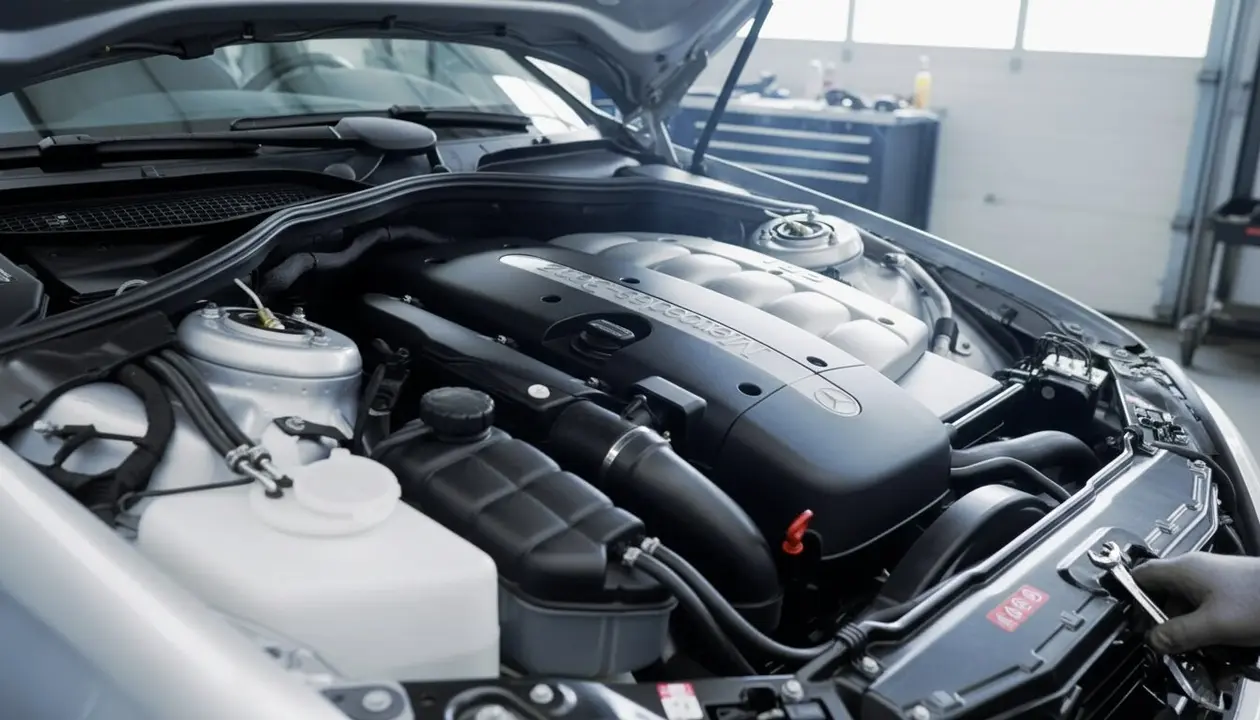

The OM648 was the last great Mercedes inline six-cylinder diesel before the leap to the V6. The source Garaje places its arrival in 2002, with a mission that explains its entire trajectory: to improve upon the OM613 and serve as a transition towards a family of engines with a different architecture. For the driver, this translated into a smooth-running engine, strong response, and a brief presence in the brand’s lineup.
The innovation that made the OM648 relevant
Why did Mercedes need this engine?
The reader looking for a Mercedes diesel from that era finds a rather direct answer: the OM648 did not appear as an isolated revolution, but rather as a finely tuned evolution of the OM613. It retained the inline six-cylinder layout and 3.2 liters, but introduced a new generation of CDI common rail direct injection technology.
This change had concrete consequences. The engine went from the OM613’s 197 hp to 204 hp at 4,200 rpm, while maximum torque rose from 470 to 500 Nm from 1,800 rpm. These are not decorative numbers: in a large sedan, having that push from such a low rev range allows gaining speed with less effort and sustaining a more relaxed delivery.
Mercedes kept a cast iron block, an aluminum cylinder head, dual overhead camshafts, and four valves per cylinder. It also incorporated a variable geometry turbocharger. The result was a combination that blended the smoothness typical of an inline six with the thrust capacity expected from a prestigious diesel sedan.
Which models debuted it?
The first model to receive it was the Mercedes S-Class W220 in its 320 CDI version. This is not a minor detail: the brand’s reference sedan usually led the way in mechanical and technological innovations. Later, the OM648 reached the Mercedes E-Class W211.
In the E-Class, it appeared with the 320 CDI badge and also with an exclusive lower-power variant identified as the 280 CDI. Therefore, the brand did not reserve the engine for a single body style, although it did keep it linked to sedans equipped with automatic transmissions and rear-wheel drive.
The available transmission was always the 5G-Tronic five-speed automatic connected to the rear axle. There were no manual versions nor all-wheel-drive variants. For today’s buyer of a used unit, this fact defines both the car’s personality and the configuration they will find on the market.
What it offered behind the wheel and on paper
How did its figures translate on the road?
The OM648 was not limited to competently moving the Mercedes E-Class and S-Class: its data show a clear difference depending on the weight and size of each sedan. In the E-Class 320 CDI W211, 0 to 100 km/h was completed in 7.7 seconds and the top speed reached 243 km/h. Its official consumption was 6.9 l/100 km.
In the S-Class 320 CDI, the same engine had to move a larger and heavier body. Therefore, the 0 to 100 km/h time rose to 7.9 seconds and the top speed was 235 km/h. The average official consumption also increased to 7.7 l/100 km.
The editorial takeaway is straightforward: the engine maintained very similar performance across both models, but the S-Class’s mass was noticeable. In overtaking, the torque available from 1,800 rpm had to provide a strong response without needing to rev the engine high; in the E-Class, the figures also reflected a more favorable balance between performance and size.
Smoothness was another of its virtues. Six cylinders arranged in line, variable geometry turbocharger, and automatic transmission formed a combination aimed at delivering power progressively. It was not an engine designed for constant shifting but to advance with composure, especially in a rear-wheel-drive sedan.
What versions of the OM648 existed?
The main version offered 204 hp and 500 Nm. Mercedes also created a lower-power alternative for the E-Class 280 CDI, maintaining the 3.2 liters displacement but reducing its figures to 177 hp and 425 Nm.
| Specification | OM648 320 CDI | OM648 280 CDI |
|---|---|---|
| Architecture | Inline six cylinders | Inline six cylinders |
| Displacement | 3,222 cc | 3,222 cc |
| Valvetrain | Dual overhead camshafts, four valves per cylinder | Dual overhead camshafts, four valves per cylinder |
| Power | 204 hp at 4,200 rpm | 177 hp |
| Torque | 500 Nm from 1,800 rpm | 425 Nm |
| Fuel system | CDI common rail diesel and variable geometry turbocharger | CDI common rail diesel and variable geometry turbocharger |
| Transmission | 5G-Tronic automatic, rear axle | 5G-Tronic automatic, rear axle |
- In favor: inline six cylinders, smooth operation, 500 Nm in the main version, and high performance for its era.
- Limitations: only offered with a five-speed automatic, rear-wheel drive, and a specific range of models.
The reason for such a short commercial life
Why was it only on sale for three years?
For readers interested in Mercedes’s technical history, here is the key: the OM648 was born when the brand was already working on a new generation of engines. Its commercial life started in 2002 and lasted barely three years, a short period for an engine that had just replaced the OM613.
The reason was not a lack of performance. Mercedes was progressively abandoning the inline six-cylinder layout to adopt a V architecture. The replacement was the OM642, a 2,987 cc V6 that occupied less space and could be more easily installed in different models.
From the owner’s perspective, this transition explains an apparent contradiction: the OM648 had competitive figures and a configuration recognized for its smoothness, but it was conditioned from the start by an architectural decision. Mercedes was not correcting a failed product; it was preparing a more flexible engine for its future lineup.
What happened after with the OM642?
The transition began in 2005. The new V6 was progressively incorporated into the Mercedes range and began replacing the OM648 in models like the E-Class. That marked the end of the inline six as the main solution for these sedans.
The contrast between both engines is revealing. The OM648 represents a traditional configuration, with 3,222 cc and six aligned cylinders; the OM642 reduced displacement to 2,987 cc and adopted a V arrangement. According to the source, this more compact architecture facilitated its installation in different models.
The subsequent trajectory was also very different. While the OM648 was limited to a three-year phase, the OM642 had a much longer life and was used in various Mercedes families. Moreover, it appeared in vehicles of other brands, including the Jeep Grand Cherokee, Jeep Commander, and Chrysler 300C.
The reality is that the Mercedes OM648 does not need a long list of versions to retain interest. Its historical value lies in having bridged two eras: the great inline six-cylinder diesels and the more compact V6s. For those seeking to identify it, the clues are clear: 3,222 cc, CDI common rail technology, 5G-Tronic transmission, rear-wheel drive, and presence in the S-Class W220 and E-Class W211.
The OM648 was a transitional diesel, but not a provisional-feeling engine. Its 204 hp, 500 Nm, and the smoothness of the six-cylinder explain its reputation; its three years of production explain its rarity. In the classic and used market, it fits better with those valuing a Mercedes sedan with a serene character and unique mechanics than with those seeking a modern setup or many transmission options.
Frequently Asked Questions
- What displacement does the Mercedes OM648 have?
- The OM648 has a displacement of 3,222 cc. It is an inline six-cylinder diesel engine, with 24 valves and a variable geometry turbocharger.
- How much power does the OM648 develop?
- The main OM648 version develops 204 hp at 4,200 rpm and delivers 500 Nm from 1,800 rpm. There was also a 177 hp variant for the E-Class 280 CDI.
- In which Mercedes models was the OM648 used?
- It debuted in the Mercedes S-Class W220 320 CDI and later appeared in the E-Class W211. In the latter, it was also offered as the lower-power 280 CDI.
- Why did Mercedes replace the OM648?
- Mercedes replaced it with the OM642, a 2,987 cc V6 with a more compact architecture. The change began in 2005 and facilitated its installation in different models.