Sotogrande sets 6 goals for 2030: the sustainable shift is already underway
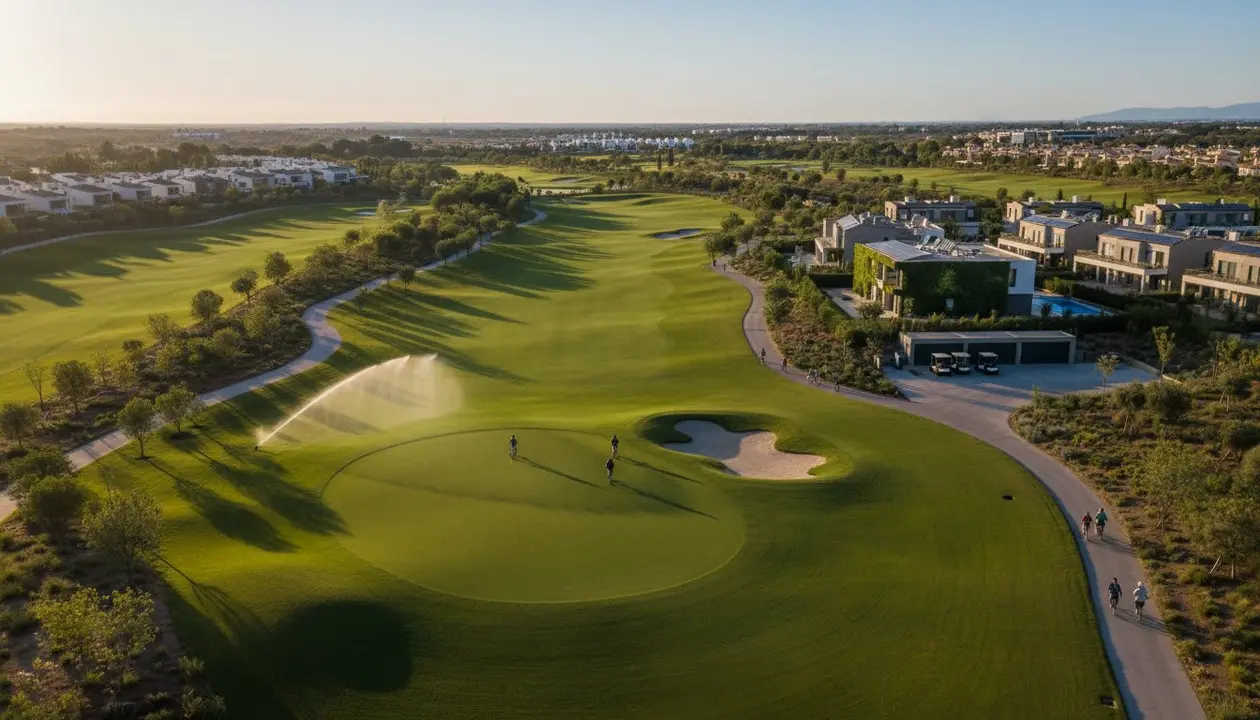
Sotogrande sets six environmental goals for 2030 and already approaches this plan with measurable progress: 23% less water consumption and 170% more photovoltaic capacity. The new document turns more than six decades of commitment to the environment into a strategy with indicators, responsibilities, and monitoring. For a residential destination in the province of Cádiz, the change is no small matter: sustainability ceases to be just a statement and becomes part of daily management.
What Sotogrande has already achieved before looking toward 2030
For those who live, work, or invest in Sotogrande, the decisive fact is that the plan does not start from scratch. The published report includes concrete results in water, electricity, and renewable energy—three especially sensitive areas in a residential and tourist destination with activity throughout the year.
23% less water and 3% less electricity
In 2025, water consumption was approximately 23% below that recorded in 2023. Electricity consumption, meanwhile, accumulated a 3% reduction compared to the same reference year.
The figures provide a first measure of the path traveled, although they also make clear the pending challenge: the goal for 2030 will be to reduce water consumption by 25% and energy consumption by 20%. In other words, the plan aims to turn an already visible improvement into a sustained and quantifiable trajectory.
Photovoltaic capacity grows by 170%
The most striking progress appears in solar energy. Operative photovoltaic capacity rose from 330 kWp in 2024 to 890 kWp in 2025, an increase of 170% thanks to the addition of the installation at the Hotel SO/ Sotogrande to the one already existing in La Reserva.
Just the hotel installation produced a total of 618 MWh of renewable energy for self-consumption during 2025 and avoided approximately 270 tons of CO₂. The next goal is to surpass 60% use of renewable energies by 2030.
- Reduce water consumption by 25%.
- Decrease energy consumption by 20%.
- Surpass 60% use of renewable energies.
- Reduce emissions by 50%.
- Reach a recycling rate of 65%.
- Keep waste sent to landfill below 10%.
What changes for people and the local economy
The plan does not limit sustainability to consumption and emissions. In Sotogrande, where residential activity, tourism, sports, commerce, and services coexist, the social and economic dimension determines much of the destination’s experience and its capacity to maintain value throughout the year.
How does the Plan position workers?
Sotogrande has 424 professionals, and 95% of its contracts are permanent. This proportion takes on special significance in a sector usually marked by seasonality and labor turnover.
Training also gains importance. During 2025, 11,119 hours were delivered, a 34% increase compared to the previous year, equivalent to 26.2 hours per employee. Content included innovation, digital transformation, artificial intelligence, sustainability, risk prevention, and regulatory compliance.
The set horizon is to reach at least 30 annual training hours per employee. The Plan also incorporates emotional well-being, work-life balance, risk prevention, and equal opportunities as priority areas. Here lies one of the most interesting readings: the destination's impact is not only measured in green hectares or kilowatts but also in the quality of jobs it generates.
How compliance with the 2030 Sustainability Plan will be measured
Its function will be to integrate environmental, social, and economic dimensions into destination management and to structure decision-making linked to the plan.
The document was born after two years of work aimed at organizing, measuring, and projecting into the future a commitment that, according to Sotogrande, has been part of the destination’s evolution for more than six decades. Rita Jordao, marketing director of Sotogrande, S.A., explains that the plan allows “organizing all that commitment, measuring it, and setting concrete goals to keep improving.”
The declaration places the change in the method: it is not presented as a beginning but as a more structured way to manage a prior trajectory. That difference matters. Without comparable indicators, an environmental promise may remain an elegant phrase; with goals and responsibilities, there is at least a basis for demanding results.
A Dashboard and dialogue with stakeholders
The system also includes dialogue with owners, residents, employees, clients, suppliers, administrations, visitors, and associations. All are integrated as stakeholders within the strategy.
The 2030 horizon includes advancing toward climate neutrality, consolidating a circular economy model, strengthening well-being, and reinforcing Sotogrande’s position as a European benchmark in sustainable residential tourism. The ambition is to move from a sustainable growth model to one based on positive impact, balancing economy, environment, people, and responsible governance.
Sotogrande reaches 2030 with already quantified results: less water and electricity consumed, more photovoltaic capacity, a predominantly stable workforce, and an economy linked to thousands of properties and hundreds of companies. The real test will be sustaining these improvements, achieving the six environmental goals, and demonstrating each advance through verifiable data. This is where it will be decided whether the plan becomes a real benchmark for sustainable residential tourism in the province of Cádiz.
Frequently Asked Questions
- What is Sotogrande's 2030 Sustainability Plan?
- It is a roadmap that organizes Sotogrande’s environmental, social, economic, and governance objectives through 2030. It includes concrete goals, indicators, responsibilities, and monitoring mechanisms.
- How much has Sotogrande reduced its water consumption?
- In 2025, water consumption was approximately 23% lower than in 2023. The goal for 2030 is to achieve a 25% reduction.
- How much did Sotogrande’s photovoltaic capacity increase?
- Operative photovoltaic capacity rose from 330 kWp in 2024 to 890 kWp in 2025, a 170% increase. The Hotel SO/ Sotogrande installation produced 618 MWh of renewable energy for self-consumption.
- What are the environmental goals for 2030?
- Sotogrande aims to reduce water consumption by 25%, energy by 20%, and emissions by 50%; surpass 60% renewable energy use; recycle 65% of waste; and send less than 10% to landfill.